
It must have happened during winter, about a thousand years ago. A group of men stand on the shore of the lake Steinsfjorden in Ringerike, Norway, fastening skis to their feet. Nearby, two strong horses snort and stamp in the snow, ready to pull the sled attached behind them. The men have been waiting for several weeks for the winter cold to freeze up the lake. Additionally, many days of snowfall have made the conditions ideal for the men to complete the task ahead. They look out over the snow-covered water; out there lies the island Ulvøya, and the stone they are to fetch. The stone has been there since summer, when it was cut in the quarry on the small island. Now the stone is to be transported nearly 50 kilometres to Dynna in Hadeland, where a grieving mother will have it inscribed with runes and images, and then set up as a memorial to a deceased daughter.
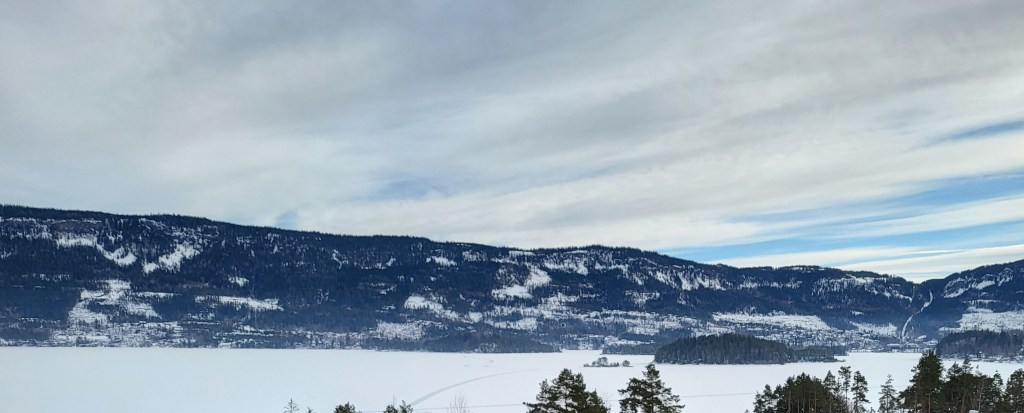
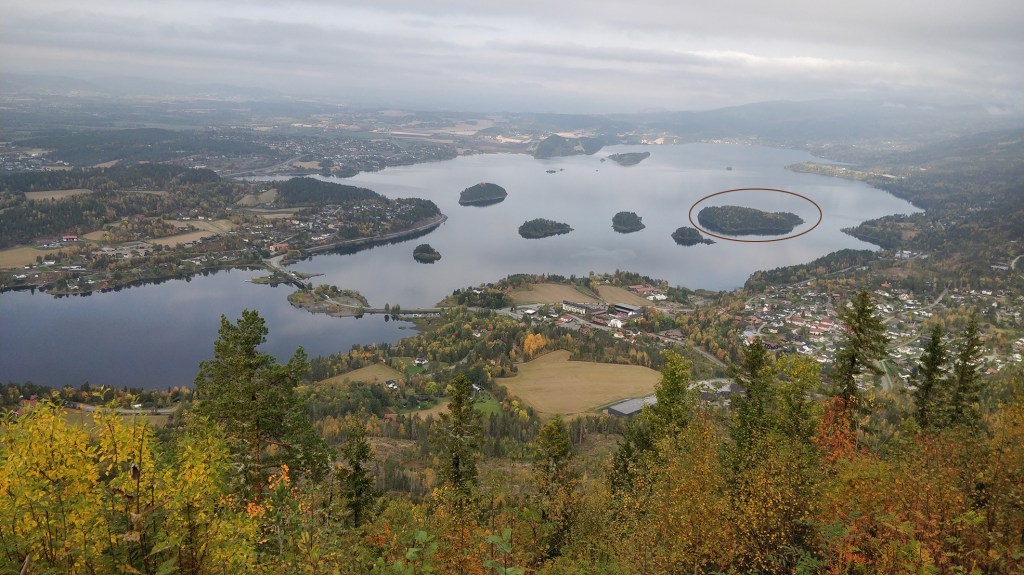
The men move across the snow-covered ice, one of them leading the two large horses pulling the sled. They land on the north side of Ulvøya, where the quarry is located. The men are dressed in warm clothes, but the winter cold makes them work quickly all the same. One of them brushes away the snow, revealing a reddish stone slab. He continues, and soon the entire stone is free of snow. Its length is almost twice the height of a man. One end is wider than even the largest among the men. Towards the other end the stone narrows. There, the width is no greater than a man’s head. The thickness, however, is quite uniform, about two handbreadths, but the stone is not completely flat. At the narrow end, which will form the top and front when it is erected, the stone bends up from the snow. It is almost like an animal’s head, slightly tilted forward. The experienced stonemasons know that this is a natural shape here on the island. Now the landscape is covered in snow, but in summer it is easy to see that the rock here on the island splits into long, flat slabs, often with such a curved shape at one end. The stonemasons also know that there is something mysterious about the rock here; it cannot be a coincidence that the splitting has such shapes. This type of stone is found elsewhere along Steinsfjorden, but there it usually splits into smaller pieces. In the quarry here on Ulvøya, however, the rock divides into long, flat slabs. In addition to the shape, the stones have a surface in which it is easy to carve magical runes and images. That is why people come here to fetch stones for commemorating the dead.
Horses and sled are maneuvered into place, and the work of moving the stone onto the sled begins. The men do not know it, but as they struggle to move the large stone, they are participating in an ancient tradition. For thousands of years, people in this area have erected large stones to honour the gods, stars, planets, moon, or the dead. Both in Ringerike and Hadeland, large stones stand in ring formations, stones whose origins are no longer known. The ring formations were once expressions of a religious cult that these men do not know. But even though the content of the religious cult has changed over the millennia, the custom of expressing religious feelings on large stones remains the same.
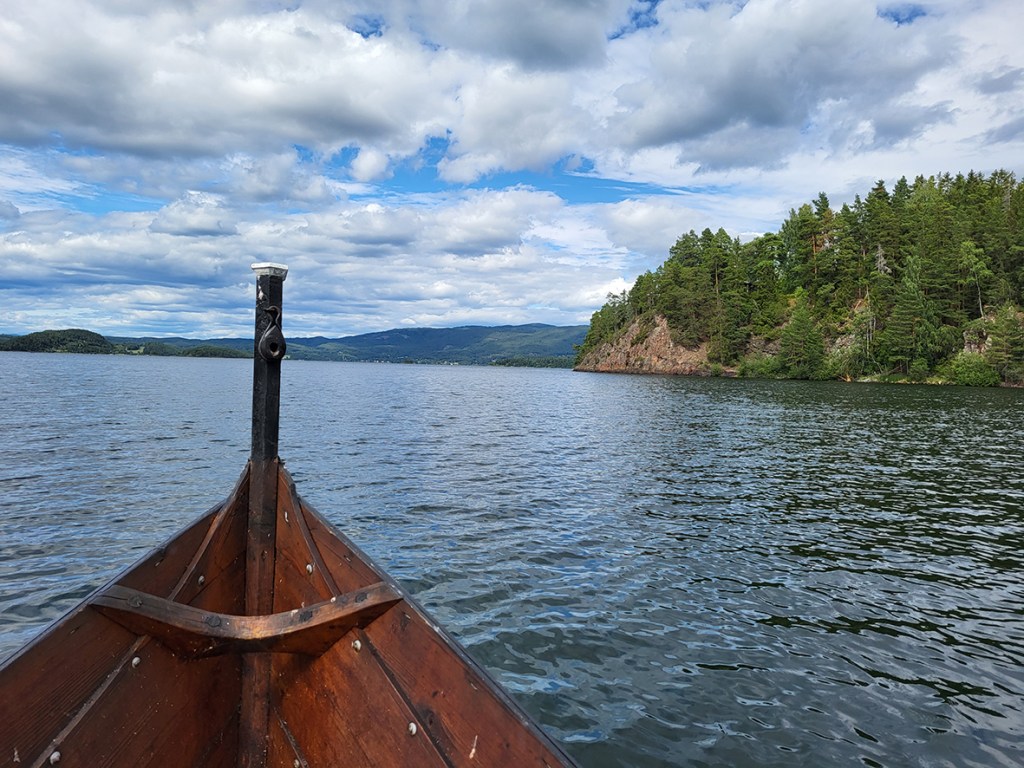
Photo: Dag Frognes
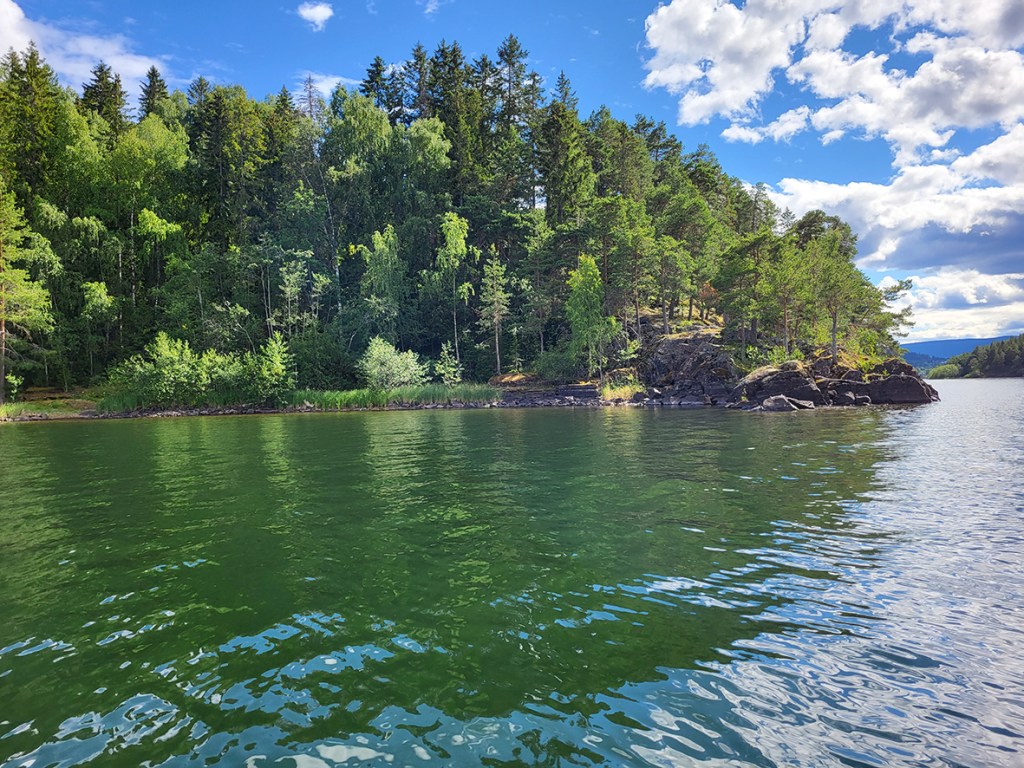
Photo: Dag Frognes
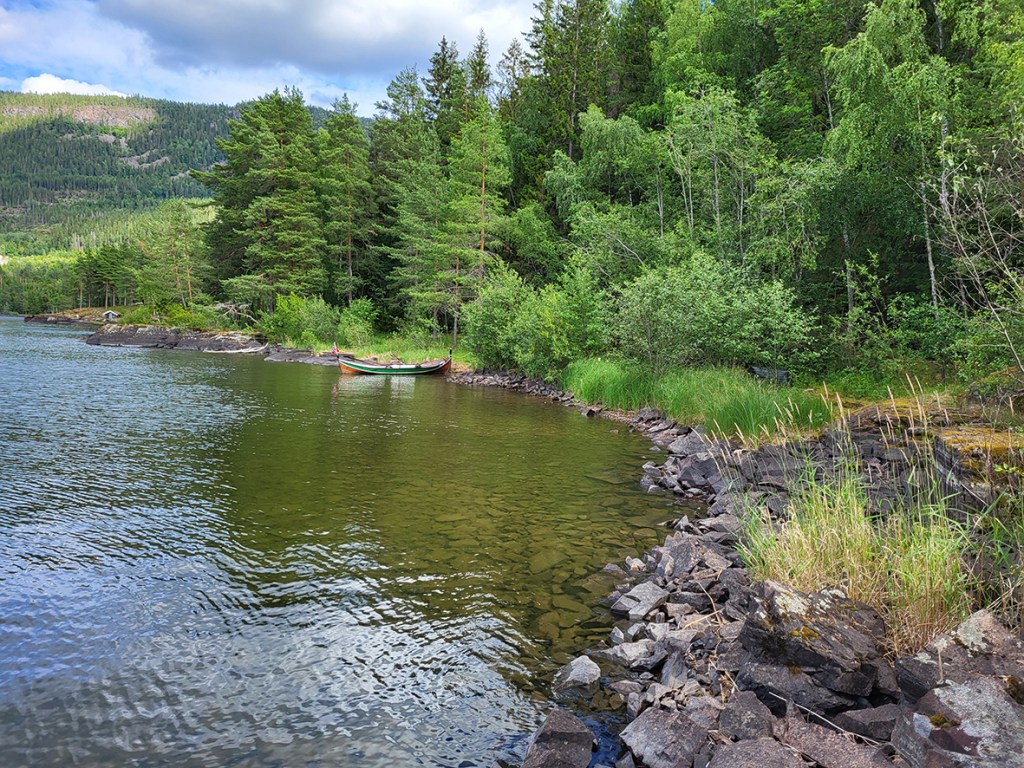
Photo: Dag Frognes
The men crossing the ice worship Thor, Odin, Freyja, and other Norse gods and goddesses, but now that faith is also changing. The stone they are moving will bear witness to new beliefs entering their society. Once at Dynna, the stone will be inscribed with runes and images that continue the Norse faith, but it will also be one of the first testimonies that the Christian faith has now come to Norway. God, Jesus, the Holy Spirit, and the Virgin Mary are all concepts that are slowly taking hold of people’s minds.
Soon the men have tipped the stone onto the sled and secured it. They then set course for the mainland.
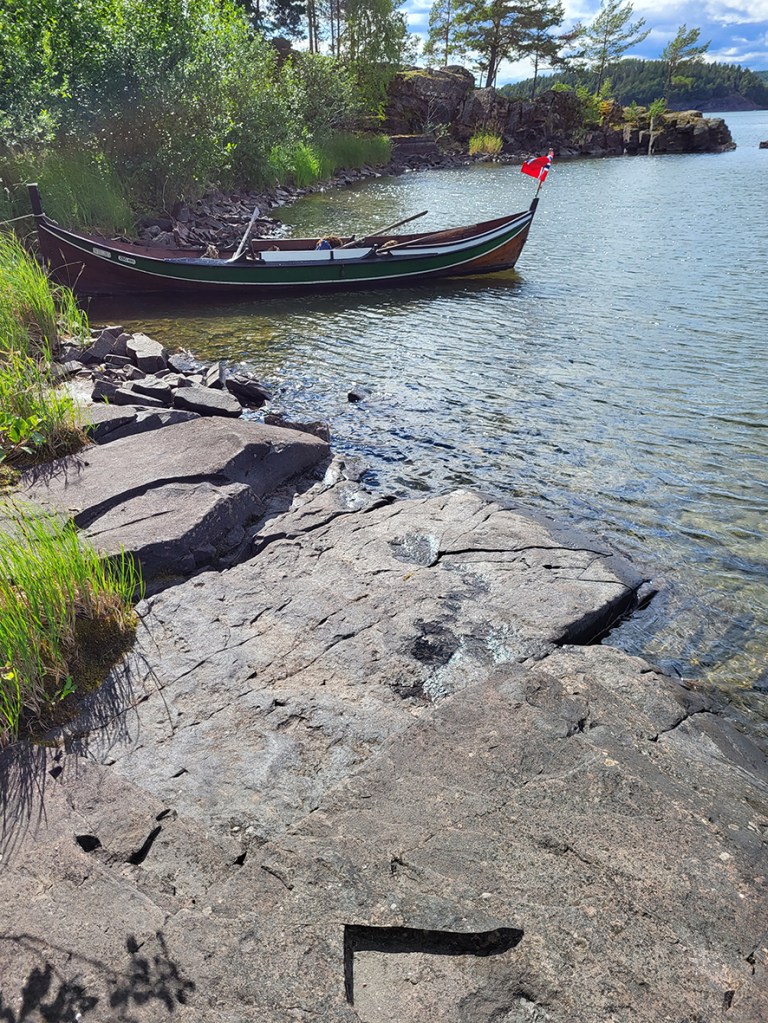
Photo: Dag Frognes
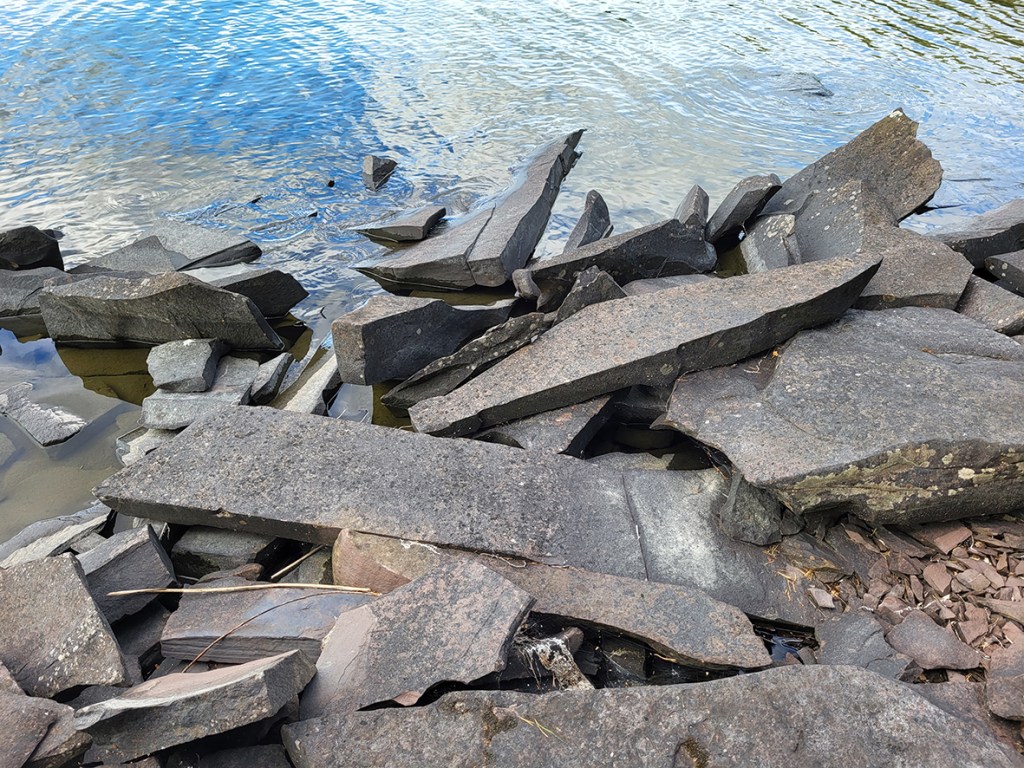
Photo: Dag Frognes
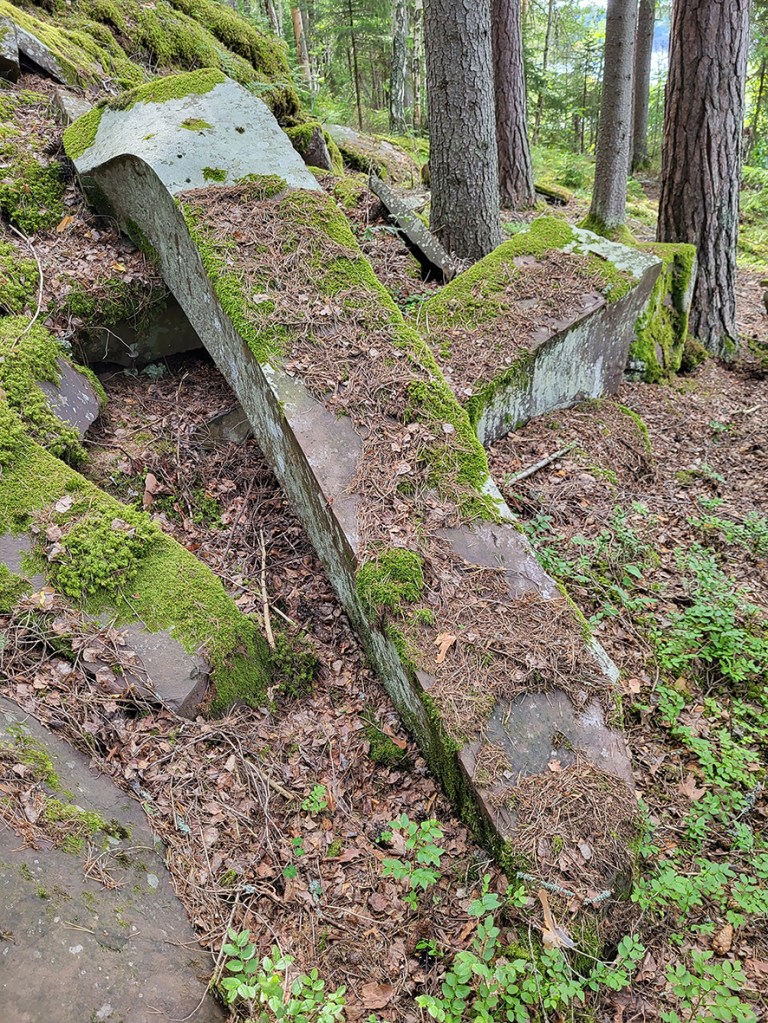
Photo: Dag Frognes
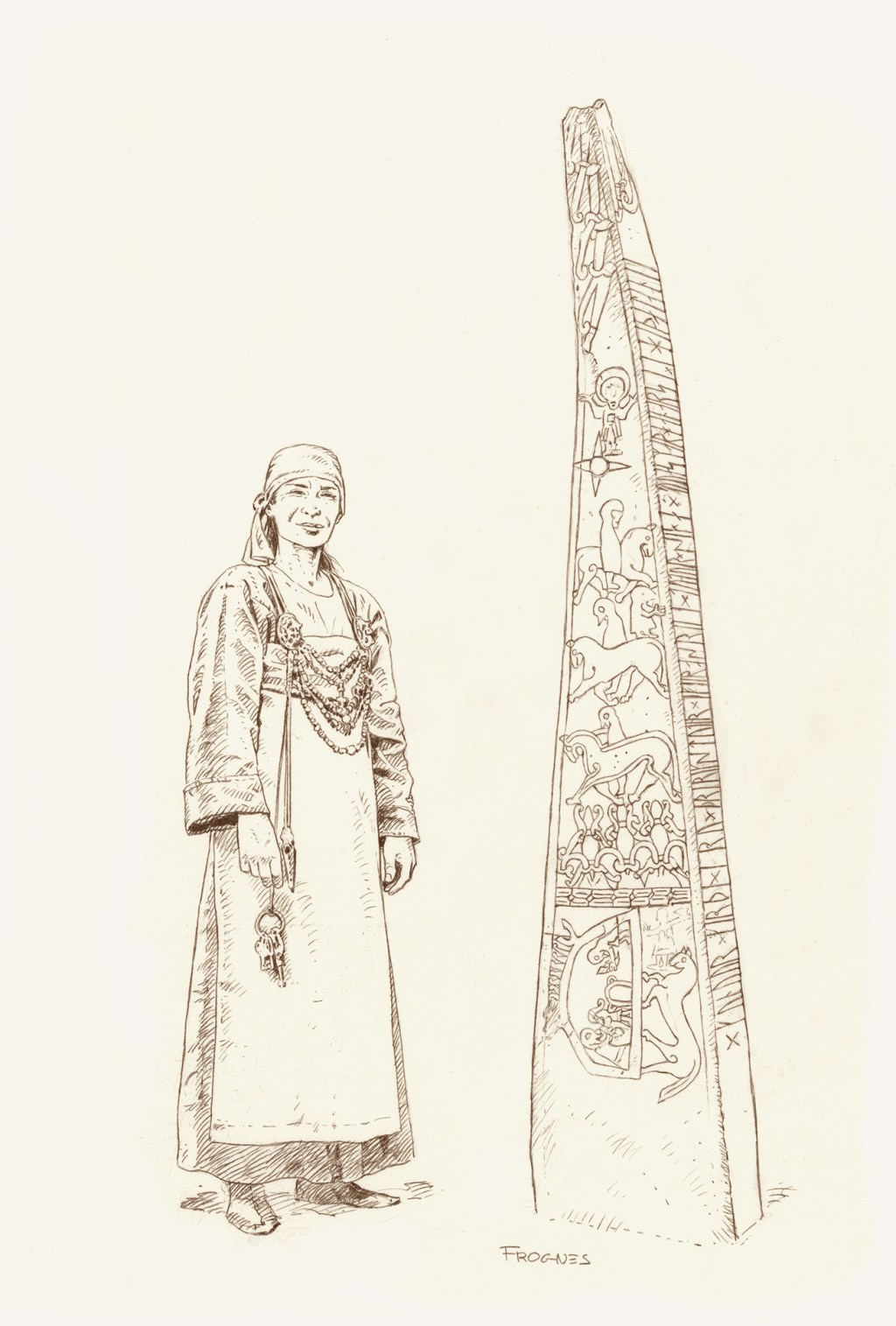
In modern times, the stone is known as the Dynna Stone, named after the farm where it stood for over nine hundred years before being moved to the Historical Museum in Oslo at the beginning of the 1900s. The stone is currently about 2.8 meters high, but the top is broken off, making it difficult to say how tall the stone originally was. The top is very narrow, so not much is likely missing, perhaps 20-30 centimetres. Near the top, the stone leans slightly forward. The runes are inscribed upwards on the right narrow side, while the images fill the broad frontside of the stone.
The rune inscription has been interpreted as: “Gunnvor, Trydrik’s daughter, made a bridge in memory of her daughter Astrid. She was the most skillful maiden in Hadeland.”[1]
So, Astrid passed away before her mother and in all likelihood, it was with great sorrow Gunnvor created the memorial for her daughter. Erecting memorial stones for the dead was common in Norse times, but not in large numbers. Compared to the later Christian tradition of gravestones in churchyards for everyone, few people received this honour in Norse society. Those who were commemorated were people from the rich and powerful families. This was likely the case with Astrid as well.
But it is not only Astrid we learn about here. The Dynna Stone is also a testament to significant societal changes that were under way at this time. On one hand, it is a memorial stone in the ancient Norse tradition that had existed for hundreds of years up to the 11th century. On the other hand, the inscription and images on the Dynna Stone are examples of how Christian beliefs had now reached Scandinavia.
Let’s first look at the reference to a bridge. In both Norse and Christian beliefs, the idea of a bridge that mediates between the human world and the afterlife has been important. In Norse mythology, there are two bridges that connect the human world with other dimensions. One is Bifrost, which stretches between the Earth and the Sky, between the human and the divine worlds.[2] The other is Gjallarbrú, which crosses the river Gjoll, the boundary between the worlds of the living and the dead.[3] As for the concept of a bridge in Christian beliefs we can compare the text of the Dynna Stone with the inscription on another stone from the same period to see the Christian context more clearly. The Eik Stone in Sokndal municipality in Rogaland, in Western Norway, has a rune inscription that has been interpreted as: “Sakse made this bridge so that God would help the soul of his mother, Turid.”[4] Here we are clearly in contact with a Christian worldview. The similarity between the textual content of the Eik Stone and the Dynna Stone, with the descriptions of the bridges, makes it reasonable to interpret the Dynna Stone’s text content as Christian, even though Astrid’s soul is not mentioned. The bridges are made in this world to invoke God’s favour, but just as in the Norse religion, a bridge in Christianity symbolized the connection between the worlds of the living and the dead, and that it was meant to lead to the salvation of the soul. To see how, we need to look to Anglo-Saxon England in the early 11th century.
Christianity in Norway around the year 1000 was largely introduced from England. Think of Håkon the Good, who grew up at the court of King Athelstan in England in the early 900s. Håkon was the first Norwegian king to try to introduce Christianity in Norway, and although he did not fully succeed, the process had begun. Later, Olaf Haraldsson brought priests from England, in 1015. His efforts to Christianize Norway had greater impact. With Olaf and his priests, the tradition of homily books likely also came to Norway. A homily book is a collection of sermons that priests could read from. One of these sermons, probably written by Archbishop Wulfstan of York (d. 1023), contains the following, translated from Old English:
[…] But let us always be hospitable. Our soul shall be Christ’s guest on the dreadful Judgment Day. Let us love our Church, for it will be our defender and protector in the great fire on Judgment Day. And let us always build and repair bridges. Even if it is just that someone takes a stone and places it in a muddy puddle so that the poor man can step with one foot on the clean side, this is a great almsgiving for him and a great reward from God. The soul also needs a straight and clean path on Judgment Day and a sturdy bridge over the slippery road with the terrors of Hell. […][5]
The Christian significance of a bridge is obvious in Archbishop Wulfstan’s sermon, where he speaks about the soul’s need for a good path to heaven on Judgment Day, but also about people’s need for good roads and bridges in this world. The bishop’s homily book was used by missionaries who came to the Nordic countries a thousand years ago. They encouraged the newly converted to build bridges, or at least to place a stone in a puddle to improve passability, in medieval landscapes with few roads and fewer bridges.
The fact that the archbishop mentions the use of a stone as footing is not coincidental. In the New Testament, Jesus is referred to as “the living stone” in 1 Peter 2:4-5: “To whom coming, as unto a living stone, disallowed indeed of men, but chosen of God, and precious, Ye also, as lively stones, are built up a spiritual house, an holy priesthood, to offer up spiritual sacrifices, acceptable to God by Jesus Christ.”[6] The idea of a stone as an important foundation can also be found elsewhere in the Bible, such as in Isaiah 28:16: “Therefore, thus saith the Lord GOD, Behold, I lay in Zion for a foundation a stone, a tried stone, a precious corner stone, a sure foundation: he that believeth shall not make haste.”[7]
Both the symbolic and practical significance of bridge-building were thus valued by the church. Where the Norse religion had previously been practiced locally on individual farms, Christianity required people to attend church services. Since churches were few and far between, the need for roads and bridges over the many marshes, streams, and rivers of the time increased. Getting people to church was important for the priests, and thus it was wise to combine promises of salvation for the soul with practical road and bridge building.
For the Dynna Stone, the bridge in question might have been built over the river Vigga. Gunnvor lived at the place that in modern times has been the Nordre Dynna farm, and a bridge over Vigga would have connected the Dynna farm with the neighbouring Bjørge farm on the other side of the river, where there was a church. This would have benefited the people at Dynna, as well as others who needed to cross Vigga.
Just as the idea of a bridge between life on earth and what comes after death had multiple resonances for Gunnvor, both Norse and Christian, we also find a symbolic ambiguity in the images on the front of the Dynna stone. These too show a mix of Norse and Christian elements. Through Norse imagery, the biblical story of the infant Jesus in the stable, the three wise men, and the star of Bethlehem is depicted.
The person or people who carved these images on the Dynna Stone used symbols from both Christian and Norse beliefs, even though the aesthetics are primarily influenced by Norse models. Is this ambiguity simply because the craftsmen had not yet broken away from their old models, or could the ambivalence of the images be due to a more complex relationship with the divine forces they addressed?
The ornaments and images on the Dynna Stone are divided into three different areas. At the top of the stone, animal ornamentation is carved on both the front and both short sides. The ornamentation continues into the part that is now broken off, so we do not know how it was concluded. The images on the front of the stone form the other two areas. These are separated by ornamentation. In the upper image field, we see from the top first Jesus, just below and to the left of this figure is a four-pointed star, probably the Star of Bethlehem. Then come three figures, one below the other. These are three horses with what are either riders or men walking beside the horses. The first horse moves to the right, while the other two go to the left. On the top horse, there is a rider, or a man walking on the horse’s right side, facing the viewer. The second horse also has a man on its right side, but for the viewer, the man is behind the horse. Additionally, the second horse has a small human figure standing on the horse’s hindquarters. The figure is facing backward, with its hand raised halfway up. The third horse and man are similar to the second, but without the figure on the horse’s hindquarters. The men could be the three wise men from the Gospel of Matthew. What the small figure on the middle horse’s hindquarters represents is unclear. Could it be a child? And what would be the significance of that? It is also unclear what it means that the top horse “goes” to the right, while the other two are moving to the left. It is also only the top rider who sits on the horse, while the two lower ones appear to walk beside their horses. It could be that the depiction is “naive” and that it is intended that all the men should be riders, or walkers, but it is difficult to say for sure.
Another perspective is that the entire scene resembles a pagan ritual, where the horses are led or ridden in procession, similar to the images found in the Oseberg ship burial. Is it really the story of the wise men from the Bible that we see here? I lean towards that interpretation – the scene is depicted in an imagery still bound to the aesthetics of Norse belief. Since the Dynna Stone was erected so early in the introduction of Christianity, this is a likely explanation. Another possibility, which does not contradict what has already been mentioned, is that the horses face both directions to show that they are moving inward or upward in the image, towards the Star of Bethlehem and the figure of Jesus.[8] It may be that the fact that the horses do not move in one direction, as is common in traditional Norse motifs, is meant to break with the old imagery and bring out a different idea: the sculptor has thus marked that the depiction is not meant to show a pagan procession, but the journey of the three wise men towards the Star of Bethlehem and the infant Jesus.
The images of Jesus, the star, and the figures with the horses on the Dynna Stone end with extensive ornamentation, which separate the top images from the scene at the bottom half of the stone. This lower, final scene has been interpreted as the stable where Jesus is born. The stable is turned 90 degrees on the horizontal axis and thus stands on its “side”. Inside the stable, there are three human figures: a lone male(?) figure with what looks like a drinking horn, and then two female figures facing each other. Between the man and the two women, something interpreted as a manger is carved. Whether one of the two women is holding something in her arms is hard to determine, as the stone is too damaged here. On the roof of the stable, some even more stylised figures are carved, but we cannot see how many of these there were originally, as the stone is damaged here too. The meaning of these “roof figures” is unclear – were they Christian angels or Norse spirits?
To the right of the stable’s underside, a horse is seen standing on its “side,” with its legs facing the stable’s underside and its head upwards towards the top of the stone. It has no rider, and its back runs along the edge of the stone. Above the horse’s head, a human figure is faintly carved, not as deeply as the other motifs. Was he intended to be part of the original decoration, or has someone outlined him later? He may have been meant as a rider who has dismounted. He holds an axe in his hand, but the meaning of this figure is uncertain.
It is generally not easy to interpret the Norse image elements on the Dynna Stone. We know too little about pre-Christian beliefs, except for one element, namely the horse figures. The horse held a special position in Norse society, both as a utility animal and as a religious animal. The horse’s central position in people’s consciousness has ensured that we have preserved many sources, both written and archaeological, about its significance. For the Dynna Stone, the following seems relevant: In pre-Christian religion, the horse was considered a sacred animal, serving as a travel companion for the dead on their journey to the realm of the dead.[9] The fact that horses figure so prominently on the Dynna Stone may indicate that it was important to retain the Norse significance of the horse’s role as a “bridge” between the worlds of the dead and the living.
If we summarize the content of the Dynna Stone’s text and images, we can say that the runes represent a Christian notion of the soul’s journey after death, while the images convey a more ambiguous message regarding belief.
Was this mix of Norse and Christian symbolism intentional on Gunnvor’s part? Did she want to “secure” her daughter’s soul after death with a memorial stone that united Norse and Christian faith? It is not unlikely; it is not even certain that there was a significant divide in Gunnvor’s religious beliefs here. She may very well have believed in both the old gods and the new god simultaneously. We can imagine a syncretic theology, where the use of the stone with images and runes represents Gunnvor’s and her contemporaries’ view on how best to relate to death and the afterlife. There are many examples in history of such parallel beliefs, especially in periods of religious encounters, and that was precisely the situation in the Nordic countries a thousand years ago. Gunnvor has secured her daughter’s journey to the afterlife with the help of both belief systems.
The Dynna Stone is a testament to a time of religious transition. Religion and politics often go hand in hand, and finally, we will look at the political situation in which the Dynna Stone was involved.
The island of Ulvøya lies just outside Stein farm on the mainland. Stein was a powerful royal centre in an area where both Saint Olaf and Harald Hardrada likely ruled at the time the Dynna Stone and other similar stones were erected.[10] Both kings were important for the introduction of Christianity. The kings’ authority may have made it important to follow them as role models – that is, to convert to Christianity and use Christian symbols in various contexts. Those who erected the rune stones from Ulvøya were powerful people in their areas and formed the network of local magnates over which the Christianizing kings ruled. The introduction of the new faith was probably forced upon some, while others converted to Christianity in the belief that it was the path to eternal salvation.
We do not know more about who Trydrik, Gunnvor, and Astrid were than what the inscription on the Dynna stone tells us, but we can be sure that they belonged to the upper class in their society at the beginning of the 11th century.
It is probably not possible to get definite answers on how these various aspects are connected, but the preceding review shows that there are some possible interpretations that can bring us closer to the worldview of Gunnvor and her contemporaries a thousand years ago.
The Dynna Stone reveals an interesting aspect of the contact between Ringerike, and Norway in general, with England. Another stone – the so-called Hønen Stone – also comes from Ulvøya. It points to a place even further away, far out in the North Atlantic. Perhaps Greenland, perhaps North America? That will be my topic for the next article.

Finally, I must thank the Hardraade Viking Ship Project, for the loan of the wonderful boat Vilja, which made possible several trips to Ulvøya.
Sources:
Primary:
Napier, Arthur (Ed.). 1883. Wulfstan. Sammlung der ihm zugeschriebenen Homilien nebst Untersuchungen über ihre Echtheit. Berlin: Weidmannsche Buchhandlung
The King James Version of the Bible. 1611. The King James Bible | Project Gutenberg
Literature:
Krag, Claus. 1995. Vikingtid og rikssamling. Aschehougs Norgeshistorie, vol 2. Oslo: Aschehoug
Liestøl, Aslak. 1973. «Innskrifta på Eiksteinen, Stavanger museum årbok 1972 (82. årgang)», edited by Jan Hendrich Lexow. 67-76. Stavanger: Dreyer
Loumand, Ulla. 2006. “The Horse and its Role in Icelandic Burial Practices, Mythology, and Society”. Old Norse Religion in Long Term Perspectives: Origins, Changes and Interactions, an International Conference in Lund, Sweden, June 3-7, 2004, redigert av Andrén, A. K. Jennbert og C. Raudvere. 130-133. Vägar till Midgård vol. 8. Lund: Nordic Academic Press
Olsen, Magnus. 1941. Norges innskrifter med de yngre runer, bind 1. Oslo: Norsk historisk kjeldeskrift-institutt
Ström, Folke. 1985. Nordisk Hedendom. Arlöv: Akademiförlaget
[1] See Olsen, 1941, p. 198 for a thorough discussion of the runes and translation
[2] Ström 1985: p. 99
[3] Ström 1985: p. 216
[4] Liestøl 1972: p. 75
[5] Napier 1883: p. 239. My translation
[6] King James Bible: The First Epistle General of Peter
[7] King James Bible: The Book of the Prophet Isaiah
[8] This interpretation is suggested by Anne Nyquist in a conversation.
[9] Loumand 2006: ff. 130-133
[10] Krag 1995: p. 148
 Dag Frognes
Leave a comment