No one who has stood and gazed out over the North Sea, even on a fine-weather day, doubts the mighty forces of the ocean. The weather in the North Sea is harsh, and wind and waves make it dangerous to travel out among them, even today. What it must have been like to sail in these waters in open ships built of slender wooden planks is not easy to imagine. But a thousand years ago, it was precisely such daring sea voyages that the people of Scandinavia undertook. They sailed out onto the sea, to the coasts of Northwestern Europe, the British Isles, and even further west: to Iceland, Greenland, and North America. By the mid-700s, the Norsemen had developed advanced shipbuilding technology. Light, elegant hulls, built of highly flexible wooden planks, along with powerful sails of wool, made it possible to sail on the open sea and up the rivers of Europe. This in turn made raiding, trade, and settlement possible. Both the Icelandic sagas and certain Anglo-Saxon poems tell of these voyages. Archaeological finds supplement what we know about these sea voyages.
The Vikings did it for plunder and riches, and to settle foreign lands. But there are other aspects to these activities as well. Two texts from the time can shed some light on the matter. One is the Anglo-Saxon poem The Seafarer, written sometime in the 10th century. The debate about the origins and meaning of the poem has been going on for a long time among scholars, but the following description from 1902, by W. W. Lawrence is interesting:
It should be observed that three leading ideas are present in the poet’s mind: the irresistible fascination of the sea for those who have sailed upon it, the hardships which seafaring involves, and the fact that men who live in comfort on the land can never realize these hardships. It is precisely the antithesis between the first and the second of these ideas which gives the piece its greatest power: in spite of a full knowledge of all the suffering which voyaging brings, the yearning to be on the sea once more is so overpowering that a man finds no pleasure in anything else.
(Lawrence 1902, 466-67)
You can read the whole poem in Old English and a line-by-line translation into modern English here.
The other text is the 13th century text Konungs skuggsiá, Old Norse for King’s Mirror. Even though strictly from the period after the Viking Age, the sentiments probably reflect the same motivations.
Transcription:
Faðer ϸar er ϸu forꝩitnar um ϸat hvat mænn sœkia ϸingat til lannz ϸæss eða hvi mænn fara þangat, isꝩa mikenn lifs haska þa drægr þar til þræfolld natura mannzens.
Einn lutr er kapp oc frægð þꝩí at þat er mannzens natura at fara þangat sæm mykels er haska ꝩan oc gera sec af þꝩi frægan. Enn annaʀr lutr er forꝩitni þꝩi at þɑt er oc mannzens natura at forꝩitna oc sia þa luti er hanum ero sagðer oc ꝩita hvart sꝩa er sæm hanum ꝩar sagt eða æige. Hinn þriðe lutr er fiarfong þꝩi at hværꝩætna leita mænn æpter feno þar sæm þeir spyria at fefongen ero þo at mykell haske se annan ꝩæg ꝩið.
(Konungs skuggsiá, 29)
Translation:
The father: You are curious about what it is that men seek in that land, or why they go there despite the great danger to their lives. This is driven by the threefold nature of man.
One part is ambition and fame, for it is in human nature to go where there is great danger and to gain renown from it. Another part is curiosity, for it is also human nature to investigate and see the things that are told to him, and to find out whether it is true or not. The third part is the pursuit of wealth, because people search everywhere for riches where they hear others have found them, even though it may be very dangerous.
(My translation)
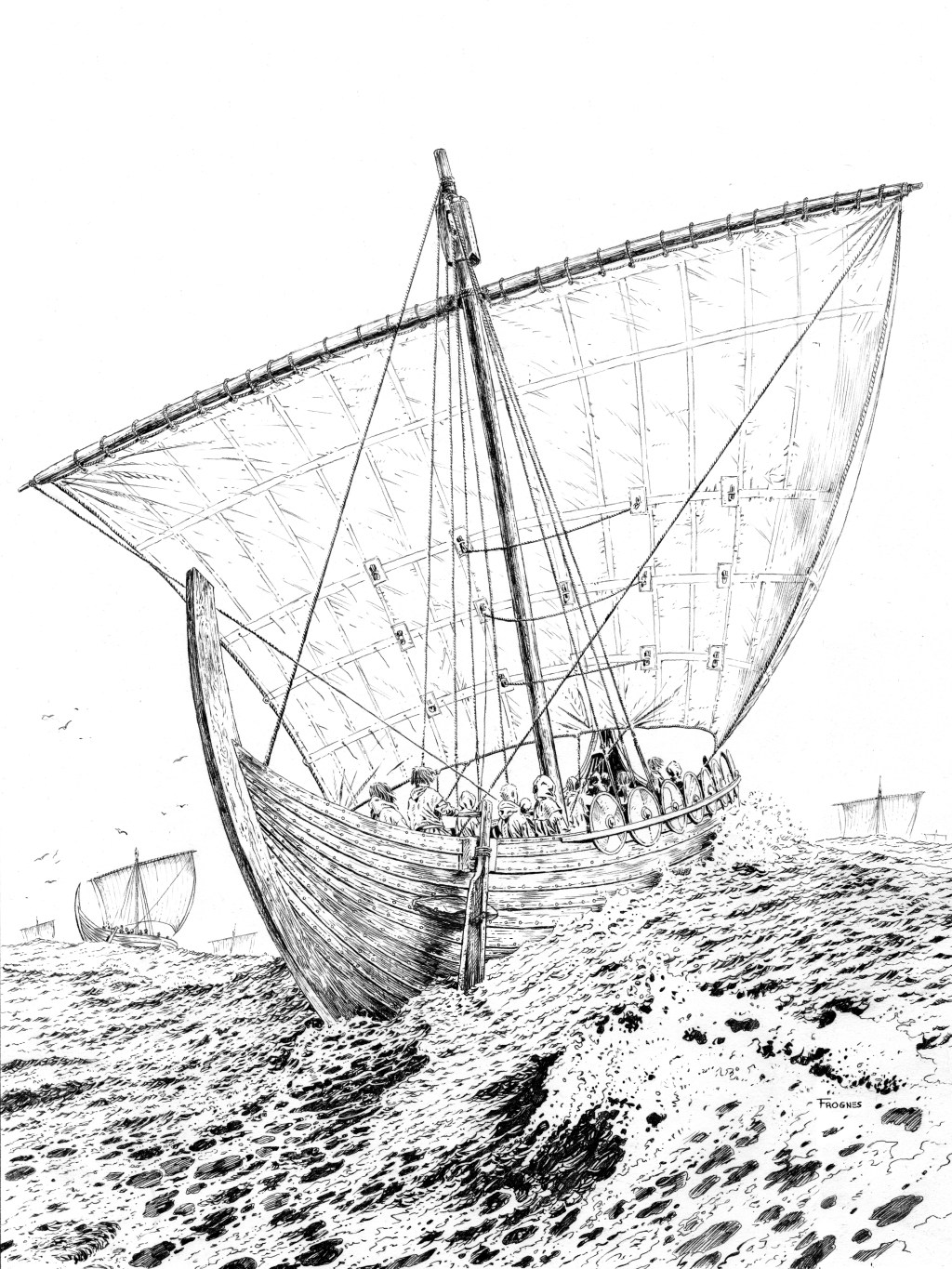
My drawing tries to capture some of the fascination the Vikings felt. Where they are going, will be up to your own imagination.
Sources:
Lawrence, William W. 1902. “The Wanderer and The Seafarer.” Journal of Germanic Philology 4 (4): 460–80
Holm-Olsen, Ludvig. 1945. Konungs skuggsiá. Oslo: Kjeldeskriftfondet
 Dag Frognes
Leave a comment